Showing posts with label TV. Show all posts
Tuesday, December 7, 2010
The Party's Over
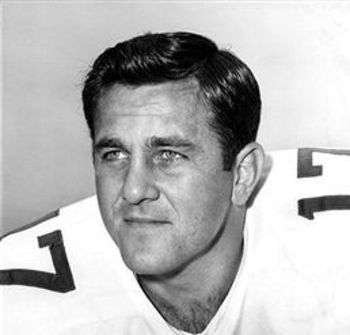
There will never be another Dandy Don Meredith. That much we know. Never the greatest quarterback for the Dallas Cowboys, he was nevertheless a very good one and an extremely tough one.
Long-time Cowboy fans like my dad probably remember the mid-'60s Cotton Bowl years as the best time to watch the team. Sure, Tom Landry's early teams couldn't get past the Packers. They lost heart-breakers in the playoffs. Meredith screwed up at the ends of big ballgames. Fans booed; sportswriters bristled. Roger Staubach would come along within a few years and make everything OK.
But real fans always have an affinity for those early teams that struggled, for the predecessors to the greats. Native New Englanders still talk with some nostalgia about Steve Grogan and the '70s Pats, about how Sugar Bear Hamilton was innocent and how the best New England team to come along prior to 2001 got robbed. Pat Patriot and the old red uniforms are still favorites around here.
As a TCU football fan, I'll forever be a Wacker Backer. I remember with fondness our rare victories in the '80s and early '90s and even some of our close losses. Stephen Shipley's last-second touchdown catch to beat Houston in 1991, in Coach Jim Wacker's last home game, remains one of my favorite sports moments. Names like Falanda Newton, Tony Jeffery and Matt Vogler are still special to me.
The championships help, of course. It's easy to remember Dandy Don now that Staubach and Troy Aikman have come and gone. Tom Brady makes the memories of Grogan seem a bit sweeter. Andy Dalton adds to Matt Vogler's nostalgic legacy. Do Cleveland fans look back with misty eyes on, say, Brian Sipe? Probably not. Success makes almost everything that preceded it seem sweeter.
Back to Dandy Don. He's one of those athletes who just predated my time, having retired a few years before I was born. And yet I feel as though I knew him, and not just because I did know him from his Monday Night Football years. He was a Dallas guy, a real one, an SMU All-American and Cowboy quarterback. He was quite literally the first Dallas Cowboy. In terms of his near misses in Dallas and lack of championship success, he was sort of my dad's Danny White, except that nobody came before Meredith in Dallas and that Dandy Don was a heck of a lot more fun than Dull Danny.
When I was a kid, Monday Night Football was still a huge event. It was still a cultural touchstone. Monday night games meant a lot--they were enormous for the cities and franchises involved, and they produced memories as lasting as many, if not most, of those that came from playoff games and Super Bowls. Howard Cosell--a television great in his own right, but one famously different from Meredith--Frank Gifford and Dandy Don made NFL football. They really did make it. No longer was the NFL a staid Sunday-afternoon fall pastime. It was cool. It was edgy. It was fun.
All of that's gone, of course. The 24-hour news cycle and the Web have swallowed the old notion of an "event," particularly one that happened every week from September through December. TV sports announcers try way too hard. Some try to be clever; others try to be controversial or bombastic, and still others try to be smarter than everybody else. Almost all of them fail. And with the NFL on five nights a week now, there are too many games and not enough good commentators.
The era of Monday Night Football ended almost 30 years ago. Don Meredith rode off into the sunset not long afterward. But with his passing, we should celebrate what he meant to Dallas sports and to American culture. No matter how badly he was hurt, no matter how much fans resented him, no matter how much flack he took from the press, he kept his cool. He didn't always win, but he never let his detractors get his goat. There's something very admirable about that. And very rare these days.
Beyond that, as an all-around fun guy, as a '70s icon, it was hard to beat Dandy Don. His decade on Monday Night Football was a high point for American entertainment and perhaps the absolute peak of the NFL as theater. But it's all over now. Meredith's days in the spotlight are long gone, and so is he. I'll miss him, not as a former fan but as someone who appreciates what he represented to a generation of football fans and to a young kid from Texas who used to beg his dad to let him stay up and watch the games on Monday nights.
The party has been over for a while, but now it's time to turn out the lights on the life of the great Don Meredith. Unfortunately, tomorrow will not start the same old thing again.
Monday, June 21, 2010
ESPN's World Cup Coverage
In recent years, I've really come to dislike ESPN. SportsCenter has become an embarrassing circus, and in general the "worldwide leader in sports" has been the lead agitator in misreporting and over-hyping sports stories. I don't even watch the network that much anymore. I almost never watch SportsCenter.
Soccer, in particular, has never come easily to ESPN. While its Champions League match coverage has generally been decent, ESPN's studio work for soccer has long been lacking, and its attempt to cover the 2006 World Cup was downright embarrassing.
In 2006, the network tried to shoehorn baseball announcers into doing play-by-play and offered a studio show full of clowns and half-experts who contributed little in terms of analysis or perspective. (Georgio Chinaglia might have been a great figure in American soccer in the '70s and is something of a likable scamp, but he was a cringe-worthy studio pundit four years ago.)
That's why it almost pains me to say that ESPN's coverage of the 2010 World Cup has been...pretty darn good. Maybe excellent. First of all, Disney decided to spring for play-by-play announcers with experience and legitimate English accents, and while Martin Tyler could show a bit more enthusiasm, he's miles better than poor Dave O'Brien was four years ago.
But where the ESPN coverage really excels this year is in the studio. The network's decision to stop pandering to American audiences with American commentators and bring in foreign experts has been a master stroke. The likes of Jurgen Klinsmann and Roberto Martinez have illuminated matches adeptly, and Ruud Gullit has been nothing short of a star with his classically blunt Dutch candor.
Steve McManaman is a bit of a loose cannon, but he knows his football. And ESPN very much did the right thing by bringing in Shaun Bartlett to offer a distinctly South African flavor. Even Alexi Lalas, often annoying and obnoxious, has toned down his presentation and has become a worthwhile studio presence, although he does have a tendency to repeat himself.
The network has stuck to football for the most part, but its brief vignettes on apartheid South Africa have been poignant and moving. Clearly the nation and the network both want to celebrate football with this World Cup and not dwell on South Africa's horrible and very recent history, but to its credit ESPN hasn't glossed over the horrors of apartheid. Even the normally Kleenex-weak Julie Foudy managed an excellent piece on black prisoners of apartheid, and Sunday's bit about South Africa's 1996 African Cup of Nations win was nothing short of inspirational. A recent piece on Youth Day in South Africa was also very good.
The real strength of ESPN's studio coverage, though, has been its American hosts. No longer just clueless question-posers, ESPN's veteran announcers have clearly studied up on football and can now discuss the game intelligently with the likes of Lalas, as well as with their foreign studio counterparts. Mike Tirico is the consummate professional as always, and Chris Fowler has performed admirably with the unpredictable McManaman sitting next to him.
The real star, however, has been long-term ESPN veteran Bob Ley, whose expertise and professionalism are at the very least equal to those of the best European commentators. Ley, somewhat marginalized by ESPN these days, reminds me during every broadcast of what the network used to be before it became a spectacle of traveling idiots. Ley is personable, knowledgeable, witty and engaging, all without being a parody of himself. He's a much-needed throwback and a refreshing presence on television in general and on sports television in particular. His work on the World Cup should win an Emmy if he's eligible for that sort of thing.
Some programming executive at Disney finally got soccer coverage right. (Surely a non-American was in charge of this process...) The result has been pre- and post-game shows very much worth watching, along with a prime-time highlights show that is one of the best to come along in years. ESPN has started broadcasting Premiership matches--West Ham's away loss to Man City was on the network last year. I've long hoped for more football coverage on ESPN and less on Fox Soccer Channel (which I still can't get in HD), and with ESPN's current World Cup lineup I'm looking forward now more than ever to watching the world's game on the worldwide leader. If only ESPN would hire Eric Wynalda back, everything would be just about perfect...but that's another post for another time.
For more on my unhealthy obsession with West Ham United and soccer, check out West Ham U.S.A.
Wednesday, May 5, 2010
748-1414
I've been on a bit of a nostalgia kick lately (more on that in some other post), and for some reason I've been digging around on YouTube for old commercials from the Dallas-Fort Worth area that I remember from childhood.
I haven't found many, to be honest--but I did manage to unearth an audio clip of the best. jingle. ever. (Hit the tiny little play button on the tiny little bar that comes up in the link to hear the tune.) It comes from the old Dallas Times Herald newspaper's vintage ad for its classified section (yes, kids, there was an era before Craigslist). The ad ran on radio and, to a lesser extent, on TV from the late '70s though, if memory serves, the late '80s. (The Herald folded almost 20 years ago, in late 1991.)
No matter, though. Hear this jingle once, and you'll never, ever forget the long-defunct (or possibly reassigned--although that's hard to imagine) phone number for the Dallas Times Herald's classified section. Advertising wizards, take note: I've seen and forgotten a million of your post-modern, ironic, too-cool-for-school spots, but I will never, ever, ever forget 748-1414. Ever. That has to mean something, right?
Thursday, April 22, 2010
Don't Start Believin'
Jack Edwards is a national treasure. Well, he's a New England treasure, in any case. The Bruins' easily excitable, overtly biased and ridiculously dramatic play-by-play announcer is like none other in sports. The call he made when the Bruins clinched a playoff berth made my eyes misty. Calling Jack Edwards enthusiastic would be like calling Wayne Gretzky half-decent. Jack is a legend, and we're fortunate to have him here.
How he has any vocal cords left after tonight, I have no idea. The B's pulled out a spectacular victory, scoring twice in the third period to erase a 2-0 deficit vs. Buffalo and then getting the game-winning goal from Miroslav Satan in double-overtime. The New Garden was rocking like the old one, and Edwards rose above the den of noise to trumpet Satan's "golden goal" (can you tell that Jack used to call the soccer World Cup?), which gave the B's a 3-1 lead in their first-round playoff series. (Sorry, I couldn't find a video of Jack's call from tonight. Trust me, though; it was epic.) One more win, and the B's move on to...
What, exactly? A date with Washington, by far the best team in the NHL this year? A date with Pittsburgh, the defending Stanley Cup champion and the team that has (arguably) the best player in the NHL in Sidney Crosby? Or maybe a shot at New Jersey, a team that always gives Boston trouble? As I've said here before, this can't end well. It never does with the Bruins--and I'm definitely not taking the Buffalo series for granted, despite the 3-1 lead. One loss in Buffalo in Game 5 (probable) followed by a bad game at home (entirely possible), and...
You see where I'm going with this. And the worst part is that if the Bruins do get past the Sabres (and I certainly hope that they do), we lose Jack (as far as I know) for the rest of the playoffs. If memory (from last season) serves, Versus takes over all broadcasts starting in the second round of the playoffs, meaning New England Sports Network will be the Red Sox channel until the fall, and Jack Edwards will have his vocal cords on ice for the summer. A playoff series loss and no Jack? That would be a double-bummer. And it's kind of likely to happen. (I could be wrong here, though--last season's Game 7 overtime loss to Carolina in the second-round series was so traumatic that I honestly can't remember which network aired it. I'm still trying to block out the memory of it altogether.)
So, at this point, all I can do is have fun with what this Bruins team--which lost 10 straight games at one point this season--is doing and ride this playoff train as far as it will go. It's one of my great sports fantasies to see the Bruins lift the Stanley Cup, and it'll likely continue to be just a fantasy after this season. For now, though, I've got Jack, a 3-1 Bruins series lead and a 12-pack of Narragansett in the fridge. I'm not believing, but I am enjoying this--for the time being. Go B's!
Labels:
hockey,
New England,
nhl,
sports,
stanley cup,
TV
Saturday, April 17, 2010
Arrested Development Movie Not Dead Yet
With The Wire, All in the Family, Seinfeld and Curb Your Enthusiasm (essentially two versions of one show), The Simpsons, Big Love, WKRP in Cincinnati (still my personal favorite), M*A*S*H and a bunch of other classics dotting the resplendent history of American television, it might be a stretch to say that Arrested Development is the best TV show of all time, at least among those produced on these shores.
But it isn't a stretch. I've watched a little TV in my time--I had a set in my bedroom when I was six--and I can say with all the objectivity I can muster that Arrested Development is the best TV show I've ever seen. (It's still not my favorite--that honor will always belong to WKRP--but it is the best.) The fact that it got the axe after just three seasons and 53 episodes almost cements its legend; it never got stale, never tried too hard and never betrayed its ridiculously quirky premise.
The incredible cast, the writing, the wit, the characters, the cameos--if you haven't seen the show, it'll be hard to understand what I'm talking about. Let me just say this: Even though Arrested Development (yes, that was an Amazon ad in that link...more on that in another post later on) was very much a serial in which every episode tied heavily into the ones that came before and after it, individual episodes of the show now rerunning on the Independent Film Channel are eminently re-watchable. Try watching a single episode of, say, The Sopranos at random--it's all out of context without being part of the greater story of the series, and the single episode isn't really all that entertaining. But Arrested Development works every time, regardless of the episode or the context.
So, with all of that on the record, I felt compelled to express my delight in reading today that the long-rumored Arrested Development movie might still be clinging to life. (It even has an IMDB entry, for what it's worth.) Granted, I'd rather see a return of the TV show, but that's highly unlikely to happen, especially given the fact that that many members of the cast have gone on to do movies and achieve enhanced stardom. Plus, I don't know that a return to TV for Arrested Development could possibly live up to my expectations for it. A movie probably won't, either, but it would be better than what we have now--reruns. Excellent reruns, but reruns nonetheless. Here's hoping that those good folks in Hollywood can get a movie together and give Arrested Development the proper send-off it deserves.
Sunday, March 14, 2010
"Really?" Yeah, Jerry Seinfeld Really Was Funny
So, I just finished watching a Saturday Night Live Weekend Update bit called "Really? with Seth and Jerry," featuring SNL Update regular Seth Meyers and sitcom legend Jerry Seinfeld.
I can't link to it because it's not online yet, obviously--it just finished maybe two minutes ago. But it was funny, which surprised me. Why? Well, I wasn't surprised that one of the players was funny. It was the other one I worried about.
New Hampshire's own Seth Meyers is reliably hilarious on SNL, but Jerry...well...here's the deal. Seinfeld the TV show was genius. It was brilliant. It was epic. It was live-changing, revolutionary. But Larry David--whose own show, Curb Your Enthusiasm, is more crude than Seinfeld but is side-splitting nevertheless--was the real creative force behind the Seinfeld sitcom.
And, let's face it, Jason Alexander and Michael Richards (the latter sadly now best known for his, well, let's just say impulse-control problems) were the acting muscle behind the Seinfeld program. Jerry was often a straight man, and Elaine was quirky, but George and Kramer made Seinfeld. Well, along with the incredible cast of characters that surrounded them. Jerry was obviously responsible for a lot of that but certainly not for all of it. Probably not even for most of it, actually.
And Jerry has had a bit of a rough run since Seinfeld ended more than a decade ago. Oh, he's not hurting for money. But his short-lived Microsoft advertising campaign with Bill Gates struggled to even approach mediocrity, and that whole Bee Movie thing--while, to be fair, I didn't actually see it--looked absolutely miserable. Add that to the fact that Jerry's stand-up act was never all that funny to begin with, and Jerry Seinfeld was starting to look like a spectacularly bright flash in the pan.
Then there's The Marriage Ref, a program so painful that I got through about the first seven minutes of it the only time I tried to watch it and genuinely wanted to pluck my eyes out with a melon baller--which I didn't do, of course, because that wouldn't have solved the equally grave problem of having to hear The Marriage Ref. I changed the channel instead.
Needless to say, I have lost some faith in the great Jerry Seinfeld over the last 12 years or so. His show made him a legend--and rightfully so. But he might not be the great entertainer I thought he was. That jury is still out. Tonight, though, live, on a show with decidedly hit-or-miss writing (although it's usually good for Weekend Update), Jerry Seinfeld was funny. Really funny. Funny like old times funny.
Somehow, that makes me feel better about entertainment in general and about comedy in particular. Ditch The Marriage Ref, Jerry, and just be one of those funny guys who shows up on TV once in a while...actually being funny, the way you were tonight. It's a role that suits you well. You've earned it. And Seth Meyers--keep up the good work, you Granite State legend.
Tuesday, March 9, 2010
Monday, March 8, 2010
Barney Miller
Thank you, WGN America, for bringing back Barney Miller, even if it is on at 1 am on Sunday night-slash-Monday morning. (Actually, this is a great time of night to watch a classic sitcom.) This show dates back to the pre-reality era in television, when people could actually write sitcoms and create characters. It also dates back to the late '70s and early '80s, before New York became Urban Disneyland and when the city was still pretty darn scary. New York is in better shape than it used to be, but the comedies about it aren't. (Seinfeld, of course, was the exception there.) Barney Miller was as outrageous as it was poignant and brilliant. There's not much of that left in television these days.
Plus, the show had one of the greatest theme songs in TV history. (One of these days, now that I've found out how to embed YouTube videos here, I'm going to run down a list of the greatest introductory songs in TV history. This one will surely be in the top five. Crank the volume on this so that you can hear the famous bass line at the beginning. This video doesn't have the best audio of all the Barney Miller clips on YouTube, but it does feature the version of the theme song I like best. Oh, and go ahead and enjoy the sweet late-'80s Volkswagen commercial that follows the tune. It's kind of a bonus. Enjoy.
Sunday, February 21, 2010
USA 5, Canada 3...Not that Anybody Saw It
That was one tremendous hockey game. Preliminary Olympic round or not, USA-Canada tonight was as thrilling as hockey gets, period. As much as I miss the old amateurs-vs.-professionals set-up that brought such joy in 1980, there's nothing like seeing the world's best go at it on the Olympic stage. Besides, with the USSR gone, sending a bunch of US college kids to take on other nations' pros would be no fun, anyway.
So, you did see the game, right? Three periods of furious, physical, fast hockey played with the kind of passion that even the Stanley Cup finals sometimes have trouble producing... You caught that, didn't you? No? Well, if you didn't, it was probably because NBC chose to bury the game on MSNBC--a "network" that I thought had ceased to exist and that I definitely don't get in high-definition.
Oh, Russia vs. Czech Republic was on live in HD on NBC this afternoon. But tonight, in prime time on a Sunday, NBC decided to go with taped replays of skiing, bobsledding and...well, I don't know what else because I watched the hockey game. I guess NBC switched to USA-Canada late in the game, but I didn't know that happened because...I was watching the game on MSNBC!
All this was tonight was Canada, the nation that created hockey, playing against the US, the nation that stole the game from the True North and overshadows Canada globally in just about every way possible. (By the way, I really like Canada, so that's not a shot at our northern neighbor--or neighbour, as the case may be.) All this was tonight was a battle on the ice not only for hockey supremacy but for the heart of Canada, which beats in rinks from St. John's to Victoria. And the US won, despite a furious fight from the home country's team.
NBC, however, decided that replaying Bode Miller's gold-medal run (what's the obsession with that guy, anyway?) and a bunch of other stuff that happened hours before it all aired would be better for ratings and advertising than broadcasting a marquee game in a marquee Olympic sport that did, let's not forget, provide us 30 years ago with the greatest moment in sports history.
Hey, NBC, today was Sunday. Most people don't work on Sunday. They could have watched Bode live if they'd wanted to. What they could not have done, however, was watch one of the biggest events of the Olympics live unless they had (and could find) MSNBC--and, even then, they (as I did) probably got the game in less-than-stunning standard definition.
NBC, you show NHL games on Sunday afternoons, and you do pretty well with the Winter Classic every year. Well, preliminary-round game or not, tonight's match-up was about a thousand times more important and thrilling than the Winter Classic was (and that's saying something coming from a Bruins fan), never mind a run-of-the-mill NHL game. Would prime-time Olympic hockey really have destroyed what have been thus far massive ratings for the Games? Or would it have boosted them even more?
Maybe this is why I'm not a TV executive, but I just can't understand why USA-Canada wasn't on the mother ship in high-def and in prime time. Bad show, NBC. You'd better hope that the US and Canada meet in the medal round because the kind of sport spectacle I watched tonight is rare and enthralling indeed. It deserves better than the dregs of basic cable.
A postscript: On the late-night show, NBC is now treating this game as if it was a massive event--which it was. Too bad it didn't merit prime-time coverage on the big network. Also, why is Cris Collinsworth commenting on hockey? Were there no former hockey players available? Granted, Jeremy Roenick and Mike Milbury have been a disaster on CNBC, especially since Milbury constantly picks fights with Roenick.
But Collinsworth? He's trying, but he knows nothing about hockey. He keeps comparing Jim Craig in 1980 to Ryan Miller tonight. Hey, Cris, Craig was a college goaltender in 1980. Miller is one of the best goaltenders in the world, an NHL star. Nice try, but the comparison isn't working. And NBC--really, you can do better. Andy Brickley has a few weeks off, and he's the best in the business. Plus, who wouldn't love to hear Jack Edwards blatantly cheer for the US? If only, NBC. If only.
Labels:
hockey,
my high horse,
sports,
TV,
what a shame,
why?
Saturday, February 6, 2010
The Hippest Trip in Midlothian
Midlothian, Texas, is about 30 miles southwest of Dallas and approximately 5 million light years away from anything hip, trendy or cool (if it's even appropriate to use those words for popular things anymore).
Well, maybe that's not the case these days (the part about Midlothian being so out of touch, that is--it's still about 30 miles southwest of Dallas). Ol' Midlo's pretty suburban now, and it's way, way bigger and much, much more cosmopolitan--relatively speaking--than it was when my parents moved me there in 1976.
The town of my childhood in the late '70s and early '80s had a few thousand people, some farm land, a couple of cement plants, a steel plant and two restaurants that weren't named Dairy Queen (along with, of course, one that was). It wasn't a bad place to grow up, but it didn't exactly provide a representative picture of anyplace but small-town Texas.
I got lucky, though. My grandmother--much to my parents' objections, if memory serves--bought me a television when I was about six years old. I had it in my bedroom, and although I didn't have cable or anything fancy like that, I did have a window to the outside world that was plugged into the wall and received a signal through rabbit-ear antennas. (Oh, and I'm an only child, so it was all mine.)
Needless to say, I watched a lot of TV. And on Saturday mornings, there were two shows I never missed: America's Top 10 (I had a weird fascination with music charts as a kid, so much so that I used to buy Billboard magazine when I could find it at the mall)...and Soul Train.
Absolutely, Soul Train. By the time I started watching Soul Train sometime in the early '80s, it was an established cornerstone of American television. And, for me, it was a telegram from the outside world as to what was cool, funky and, frankly, not the product of white small-town Texas. In a town full of country-music lovers and headbangers (not that there's anything wrong with that...), there wasn't a lot of soul, nor was there really much interest in "urban music" until rap finally came to Midlo sometime in the late '80s.
I didn't always like the music on Soul Train, but I usually did...and I always loved the dancing. And the fashions. I just wasn't going to see anything like that in Midlothian, Texas...well, ever. Really, the music and the dancing were the best reasons to like Soul Train. And its super-smooth host, Don Cornelius, had a style that any young man would have done well to emulate...but that none could ever duplicate.
Did it help that Soul Train was a mostly urban, mostly black show? Sure, it did. There weren't many black kids in Midlothian, and although Dallas-Fort Worth overall is a diverse area, my little far-flung corner of it wasn't exactly multicultural. We had plenty of "urban" radio stations in the D-FW market, but Soul Train brought urban black culture to life in a way in which the radio never could. The styles, the trends, the astonishing moves of the dancers and the sheer joy of the famous Soul Train line were all nice breaks from the typical twang and bang I heard at school and with friends and their parents.
As it turns out, Don Cornelius would likely be happy with my impressions of the show. As anybody who watched tonight's Soul Train documentary on VH1 now knows, the show actually has a fascinating history that goes way beyond afros and butterfly collars. Cornelius, a TV reporter at the time, started the show in Chicago at the end of the '60s because he got tired of seeing black faces on TV associated mostly with crime and poverty. He sought a more positive image of urban black life--and, man, did he provide it.
The show went national within a very short time and took off like a rocket. It was thanks in large part to Soul Train that Americans of all kinds not only heard great artists (often for the first time) but also got a positive view of urban black culture on television. Cornelius, who owned the show, is a great American entrepreneur, period, and is a genuinely important figure in black history in particular (I think, anyway.). I can't say that I had much of a preconceived notion of black people or black culture when I was a kid (the result of good parenting, I'd say), but I am one of those white kids who got hooked on urban black styles and music largely as a result of my Saturday morning viewing ritual.
By the time I was in high school, I was in full rebellion against Midlothian's suffocating cowboy culture. I sported rayon shirts, baggy (although not MC Hammer baggy...) slacks and, sometimes, purple suede shoes. I even had an entire purple suit cut in the popular early '90s style with a short jacket, blousy pants and funky-collared shirt. If I could have had one of those Kid 'n Play afro fades, I would have. I listened to the music I heard on Soul Train (along with a lot of other stuff, of course) and did my best to look like the people on the show. My mother took me on countless clothes-shopping trips to Red Bird Mall--the mall closest to Midlothian, it was located, fortunately for me, in a heavily African-American South Dallas neighborhood.
The dancing part of my Soul Train style never did come along the way I hoped...ahem. But it's important to understand that I wasn't mocking the culture I saw on Soul Train. I was very genuinely trying to emulate it. (OK, so maybe I shouldn't have bought the Africa medallion. I got a little carried away, OK?) I liked that culture, or at least what I thought it to be. I though it was cool and different and maybe the way things were heading trend-wise throughout the whole country, if not in Midlothian.
As it turns out, I was ahead of my time, for once. The generation just behind mine is fascinated with black culture--the music, the clothes, the approach to life. A friend who teaches high school told me the other day that the few black kids in his private Catholic school walk around like kings because the white kids there look up to them. I can relate to that to some extent; I was always very proud to have come in second place in the voting for best-dressed male in my senior class. The winner was a black guy who really did look entirely less ridiculous in his clothes than I did in some of mine.
By the time I got to college, I realized that the whole white-boy Soul Train thing wasn't going to work in the outside world--it seemed to most people as though I really was mocking black people, so I went back to jeans and t-shirts. But I kept listening to Soul Train music, even if I didn't see the show much anymore. And while I can't say that I'm much of a fan of today's hip hop (and neither, by the way, is Don Cornelius), I do still have an appreciation for great soul music of all sorts of varieties.
These days, Soul Train more than lives on via YouTube. Some of the live performances it hosted are truly spectacular. I'll probably spend a few hours one of these days watching old clips and thinking about Don Cornelius--a guy who helped open my eyes to an unfamiliar world--wishing us, as always, love, peace and soul.
Sunday, June 21, 2009
Beer and Sincerity
I had the pleasure recently--I won't tell you when, in case anybody from work is reading--to watch some old North American Soccer League games on DVD. Most of these games were from the late-'70s; two of the DVDs were ABC Sports season previews for the 1979 and 1980 campaigns, starring the legendary Jim McKay, some extremely simplistic graphics and a fair amount of modified instrumental disco music.
It would be easy and entertaining enough to prattle on for a while about the soccer (sorry, Euro friends) itself...or about the season previews, both of which included long and fairly detailed explanations of exactly what the rules of soccer--which happens to be the world's simplest team sport--are. But what really left an impression on me was--what else?--the commercials. Is it any wonder advertising works so well?
There was all kinds of fun stuff: old ads from WFAA-TV, Dallas-Fort Worth, featuring racing legend Johnny Rutherford squinting into the sun and selling mufflers or something; the old Aamco "double-a, m-c-o" ads for whatever Aamco is or was; Kenny Cooper (the original--the long-time Dallas Tornado goalkeeper) hocking a soccer ball for only $8.95 and six Dr. Pepper bottle caps; the cheesy old "Coke adds life" Coca-Cola spots.
But what really left an impression on me was the beer ads. Pearl's "First in the heart of Texas" campaign had a fairly modern flavor, with the requisite chicks in tight shirts and young people having good times on display. But the other beer ads--for Budweiser and Miller High Life, because there were really not that many other beers for sale in the US back then--were different. They were...surprisingly sincere.
OK, so the Bud ads were somewhat macho, featuring racing cars...well, racing. But there was no humor to Bud's commercials; there were no frat guys carousing or hot girls lathering themselves up. There were no double-entendres, no over-acted high fives, no fist bumps...and no warnings of any kind about drinking and driving or enjoying alcohol responsibly. There was just racing-car footage and then the hard sell.
More striking, though, were the "Miller time" ads offered up by Miller High Life. "Miller time," of course, became something of a catch phrase in the '70s and well beyond, trotted out when a day of hard work was done and it was time to relax and kick back with a not-even-mediocre domestic brew. (But, then again, who knew back then that American beer was lousy? There weren't many imports, and the ones that were available weren't exactly great; and the micro-brew movement was just about two decades away from taking off in any serious way.)
The funny thing about the Miller ads was that they weren't funny. While Bud went for fast cars and no storyline, Miller opted for macho men doing macho things--with no sense of irony or humor whatsoever. One ad featured cowboys riding the range all day and then relaxing in the evening with a cold can of Miller High Life--evidently, the West hadn't entirely been conquered by 1979.
Another ad, the most memorable by some distance, opened with a shot of a guy who was supposed to be some sort of longshoreman, although he frankly looked more like a forgotten '70s pop star (and maybe he was)--not the glamorous kind, but the "singer-songwriter" kind with a fluffy perm and rather wonky looks. Anyway, this (white, for reference) dude was clearly agitated and was yelling at somebody. We quickly came to find out that he was bossing around his (multi-racial--that is to say, there was one black guy) co-workers while loading cargo onto a ship.
The voice-over, like something from a Saturday Night Live skit (now some of that show's early commercial parodies make a lot more sense to me) came on with a manly tone and, without a hint of irony, blasted something along these lines:
"You work on the docks. The work is too hard. The day is too hot. The weight is too heavy. But when you've got that cargo loaded into the belly of that ship and the whistle blows at the end of your shift, it's..." (cue primitive graphic covering most of the screen) "Miller time!"
Cut to a bar scene featuring our pop-star longshoreman and his integrated crew laughing it up at a wonderfully '70s, rather darkly lit, wood-paneled bar. They're horsing around and having a ball when the pop star hears the whistle of the ship he had been loading that day as the mighty vessel heads out to see. In that moment, he feels (we guess) a swell of pride, and a look of accomplishment and satisfaction comes over his face that can only signify his pride in a job well done. The music swells...and scene.
OK, so maybe it's not funny all spelled out like that, but it's hilarious to watch in the context of what beer commercials--and our culture--have become. A few things about this ad in particular stood out to me:
1. It was entirely sincere. The dock workers were real dock workers (or portrayed as such), not too-cool-for-school slackers trying to put one over on the boss or play some sort of trick. They weren't hitting on chicks or screwing around on lunch break; they were breaking their backs. What that tells me is that the target market for beer ads has changed. It used to be the middle-aged, blue-collar, Red Forman-from-That '70s Show kind of guy. Now, it's the frat daddy or 20-something hipster who can't get enough of himself and his impossibly hip buddies.
2. The reason the market has changed is because Red Forman has mostly disappeared from this country. The factory worker, the dock worker, the construction worker--basically the Village People minus the policeman and maybe the cowboy--these guys are still around, but they're a disappearing breed (quickly disappearing these days), and the ones who are left don't have the disposable income that white-collar 20-somethings have. Blue-collar, salt-of-the-earth guys used to rule this country, at least in terms of being the guys advertisers wanted to reach; now, they're jokes, portrayed as rednecks or washed-up old men or neglectful fathers. That's a shame, really. It's unfair, and it's a symptom of the greater problem of hipsterism that plagues this country. But I'm digressing here...
3. It's hard to find any commercial on TV now that's not ironic or silly or that doesn't at least try to be funny. OK, so maybe some of the prescription-drug ads are pretty dry, but even lame household products like the Swiffer get pitched with singing mops and dancing brooms. Sincerity is seriously uncool in our culture right now.
We embrace idiots, malcontents and flippant jokesters as our fictional (and often real-life) heroes. We're addicted to irony and goofiness--and that's not all bad. After all, the bland straight-and-narrowness of old cop shows and '80s sitcoms (think Cosby and Family Ties) did get tiresome pretty quickly and way outlive their entertainment value.
But we seem over the last decade-and-a-half or so to have lost the bravery to really like or believe in something--even a fictional character--in our culture. And when someone genuine does come along (I hate to say it, but I'm going with Susan Boyle here), the backlash against that thing or person from super-cool bloggers and know-it-all social commentators is swift and strong. Even Susan lost the competition that made her a YouTube star worldwide, and while she probably still has a lot of adoring fans, the culture-controlling set seems to have deemed her too real to be accepted into the, ahem, culture club.
Even Susan Boyle only became momentarily popular because we could laugh at her as soon as we looked at her. She was old, fat, pathetic, a virgin--a joke or parody of some sort in our culture, surely the kind of person who didn't really exist in real life. But she quickly became genuine, not only with her voice but also with her lifestyle, her looks and her background. She was real, and she seemed to like herself that way, and we couldn't really handle that.
American Idol and all the other lousy no-talent shows that have taken over the mainstream airwaves have tried to force sincerity, but they're mostly just a lineup of freaks and hipsters trying to out-cool each other with a panel of judges that mostly serves to reinforce unfortunate stereotypes (the business-like white guy, the cool black guy, the emotional woman.) Any sincerity there is forced and staged--and it's easy to tell that it's not real. That's why Susan Boyle was such a shocker and why now, only a few weeks after she made the world look, she's not much more relevant than a '70s beer commercial featuring an earnest dock worker.
There are times when I get really nostalgic for the '70s, even though I was a little kid back then. I miss television that mattered and characters that made us think. Would All in the Family or M*A*S*H even get a pilot produced in 2009? Doubtful. Hey, I love Family Guy and Reno 911 and a lot of funny commercials. But I wouldn't mind seeing that '70s dock worker from the Miller ad come back in the form of a factory worker or waitress or construction worker in 2009--a genuine person, honest, hard-working, somebody trying to hang on and support a family in tough times.
If we overdosed on sincerity in the '80s, surely the pendulum has swung well the other way. We could stand to "keep it real" a little more often in our culture--really real, uncool, modest...sincere. The ship's pulling away, and the dock worker is swelling with pride. I'm not going to laugh at him, personally. I'm going to buy him a beer--and probably something better than a Miller High Life.
It would be easy and entertaining enough to prattle on for a while about the soccer (sorry, Euro friends) itself...or about the season previews, both of which included long and fairly detailed explanations of exactly what the rules of soccer--which happens to be the world's simplest team sport--are. But what really left an impression on me was--what else?--the commercials. Is it any wonder advertising works so well?
There was all kinds of fun stuff: old ads from WFAA-TV, Dallas-Fort Worth, featuring racing legend Johnny Rutherford squinting into the sun and selling mufflers or something; the old Aamco "double-a, m-c-o" ads for whatever Aamco is or was; Kenny Cooper (the original--the long-time Dallas Tornado goalkeeper) hocking a soccer ball for only $8.95 and six Dr. Pepper bottle caps; the cheesy old "Coke adds life" Coca-Cola spots.
But what really left an impression on me was the beer ads. Pearl's "First in the heart of Texas" campaign had a fairly modern flavor, with the requisite chicks in tight shirts and young people having good times on display. But the other beer ads--for Budweiser and Miller High Life, because there were really not that many other beers for sale in the US back then--were different. They were...surprisingly sincere.
OK, so the Bud ads were somewhat macho, featuring racing cars...well, racing. But there was no humor to Bud's commercials; there were no frat guys carousing or hot girls lathering themselves up. There were no double-entendres, no over-acted high fives, no fist bumps...and no warnings of any kind about drinking and driving or enjoying alcohol responsibly. There was just racing-car footage and then the hard sell.
More striking, though, were the "Miller time" ads offered up by Miller High Life. "Miller time," of course, became something of a catch phrase in the '70s and well beyond, trotted out when a day of hard work was done and it was time to relax and kick back with a not-even-mediocre domestic brew. (But, then again, who knew back then that American beer was lousy? There weren't many imports, and the ones that were available weren't exactly great; and the micro-brew movement was just about two decades away from taking off in any serious way.)
The funny thing about the Miller ads was that they weren't funny. While Bud went for fast cars and no storyline, Miller opted for macho men doing macho things--with no sense of irony or humor whatsoever. One ad featured cowboys riding the range all day and then relaxing in the evening with a cold can of Miller High Life--evidently, the West hadn't entirely been conquered by 1979.
Another ad, the most memorable by some distance, opened with a shot of a guy who was supposed to be some sort of longshoreman, although he frankly looked more like a forgotten '70s pop star (and maybe he was)--not the glamorous kind, but the "singer-songwriter" kind with a fluffy perm and rather wonky looks. Anyway, this (white, for reference) dude was clearly agitated and was yelling at somebody. We quickly came to find out that he was bossing around his (multi-racial--that is to say, there was one black guy) co-workers while loading cargo onto a ship.
The voice-over, like something from a Saturday Night Live skit (now some of that show's early commercial parodies make a lot more sense to me) came on with a manly tone and, without a hint of irony, blasted something along these lines:
"You work on the docks. The work is too hard. The day is too hot. The weight is too heavy. But when you've got that cargo loaded into the belly of that ship and the whistle blows at the end of your shift, it's..." (cue primitive graphic covering most of the screen) "Miller time!"
Cut to a bar scene featuring our pop-star longshoreman and his integrated crew laughing it up at a wonderfully '70s, rather darkly lit, wood-paneled bar. They're horsing around and having a ball when the pop star hears the whistle of the ship he had been loading that day as the mighty vessel heads out to see. In that moment, he feels (we guess) a swell of pride, and a look of accomplishment and satisfaction comes over his face that can only signify his pride in a job well done. The music swells...and scene.
OK, so maybe it's not funny all spelled out like that, but it's hilarious to watch in the context of what beer commercials--and our culture--have become. A few things about this ad in particular stood out to me:
1. It was entirely sincere. The dock workers were real dock workers (or portrayed as such), not too-cool-for-school slackers trying to put one over on the boss or play some sort of trick. They weren't hitting on chicks or screwing around on lunch break; they were breaking their backs. What that tells me is that the target market for beer ads has changed. It used to be the middle-aged, blue-collar, Red Forman-from-That '70s Show kind of guy. Now, it's the frat daddy or 20-something hipster who can't get enough of himself and his impossibly hip buddies.
2. The reason the market has changed is because Red Forman has mostly disappeared from this country. The factory worker, the dock worker, the construction worker--basically the Village People minus the policeman and maybe the cowboy--these guys are still around, but they're a disappearing breed (quickly disappearing these days), and the ones who are left don't have the disposable income that white-collar 20-somethings have. Blue-collar, salt-of-the-earth guys used to rule this country, at least in terms of being the guys advertisers wanted to reach; now, they're jokes, portrayed as rednecks or washed-up old men or neglectful fathers. That's a shame, really. It's unfair, and it's a symptom of the greater problem of hipsterism that plagues this country. But I'm digressing here...
3. It's hard to find any commercial on TV now that's not ironic or silly or that doesn't at least try to be funny. OK, so maybe some of the prescription-drug ads are pretty dry, but even lame household products like the Swiffer get pitched with singing mops and dancing brooms. Sincerity is seriously uncool in our culture right now.
We embrace idiots, malcontents and flippant jokesters as our fictional (and often real-life) heroes. We're addicted to irony and goofiness--and that's not all bad. After all, the bland straight-and-narrowness of old cop shows and '80s sitcoms (think Cosby and Family Ties) did get tiresome pretty quickly and way outlive their entertainment value.
But we seem over the last decade-and-a-half or so to have lost the bravery to really like or believe in something--even a fictional character--in our culture. And when someone genuine does come along (I hate to say it, but I'm going with Susan Boyle here), the backlash against that thing or person from super-cool bloggers and know-it-all social commentators is swift and strong. Even Susan lost the competition that made her a YouTube star worldwide, and while she probably still has a lot of adoring fans, the culture-controlling set seems to have deemed her too real to be accepted into the, ahem, culture club.
Even Susan Boyle only became momentarily popular because we could laugh at her as soon as we looked at her. She was old, fat, pathetic, a virgin--a joke or parody of some sort in our culture, surely the kind of person who didn't really exist in real life. But she quickly became genuine, not only with her voice but also with her lifestyle, her looks and her background. She was real, and she seemed to like herself that way, and we couldn't really handle that.
American Idol and all the other lousy no-talent shows that have taken over the mainstream airwaves have tried to force sincerity, but they're mostly just a lineup of freaks and hipsters trying to out-cool each other with a panel of judges that mostly serves to reinforce unfortunate stereotypes (the business-like white guy, the cool black guy, the emotional woman.) Any sincerity there is forced and staged--and it's easy to tell that it's not real. That's why Susan Boyle was such a shocker and why now, only a few weeks after she made the world look, she's not much more relevant than a '70s beer commercial featuring an earnest dock worker.
There are times when I get really nostalgic for the '70s, even though I was a little kid back then. I miss television that mattered and characters that made us think. Would All in the Family or M*A*S*H even get a pilot produced in 2009? Doubtful. Hey, I love Family Guy and Reno 911 and a lot of funny commercials. But I wouldn't mind seeing that '70s dock worker from the Miller ad come back in the form of a factory worker or waitress or construction worker in 2009--a genuine person, honest, hard-working, somebody trying to hang on and support a family in tough times.
If we overdosed on sincerity in the '80s, surely the pendulum has swung well the other way. We could stand to "keep it real" a little more often in our culture--really real, uncool, modest...sincere. The ship's pulling away, and the dock worker is swelling with pride. I'm not going to laugh at him, personally. I'm going to buy him a beer--and probably something better than a Miller High Life.
Thursday, June 11, 2009
Another Swine Flu Reference
This one was in an episode of King of the Hill...an episode from 2004, long before the current Swine Flu officially became a pandemic (the first in 41 years! Yeah!). So, somebody remembered the Swine Flu from the '70s, after all. I am strangely gratified by this. Mike Judge, I remain in awe of your genius. You make all Texans proud.
A Real Belter, Mexican Style
Given that I'm cheering, of course, for the US to qualify for the World Cup (that's soccer for us Yanks and football for most of the rest of the world), I probably shouldn't be enjoying great goals scored by our rivals, the Mexicans. But Oscar Rojas's goal in Wednesday night's World Cup qualifier vs. Trinidad and Tobago (neither of which could beat Mexico, which won 2-1 on the Rojas goal) was a real belter. Watch and enjoy.
A few other notes about the game: I fired it up on the netbook live on the fantastic site justin.tv, which offers all kinds of live sports programming from all over the world (probably of questionable legality--but who cares?). I turned the sound down because I wasn't in the mood for the babble of Spanish commentary, although sometimes I quite enjoy it.
Anyway, the Mexican TV coverage was actually very good and included some scenes rarely seen on US or European TV. There were crowd shots, but not the typical cheering-and-scarf-waving stuff; some of the images seemed to show a scrap or two taking place between rival fans. Nothing serious--mainly handbags, as the Brits would say, but interesting to see nonetheless. But better than that was a fairly gratuitous shot, during play in the second half, of a not unattractive (ahem) young lady wearing some sort of fairy wings (I have no idea) and prancing around in pants that we might call form-fitting. Now that's some superb camera work.
Doubtless all of this will show up on YouTube at some point, but I'm too tired to look for it tonight. You have the goal; that'll have to be good enough for now. Muchos kudos to Mexican TV, though, for interrupting the action for a mild cheesecake shot and a few minor crowd-fight scenes. That sort of thing just gives the viewer a sense of, you know, the atmosphere in the stadium and all...especially the fairy girl. She had a lot of atmosphere. But I digress.
Speaking of the World Cup, I can rest easy on one front, as the European nation I support, the Netherlands (better known as Holland in football circles, although Holland is, of course, only part of the Netherlands) has already qualified for South Africa 2010. Now, if the Oranje can just recreate their performances in the opening rounds of Euro 2008 and avoid dropping another floater like the one they dropped vs. Russia in the Euro, World Cup 2010 could become very interesting indeed. It's exactly a year away...well, today, now that it's Thursday morning. I can't wait. Oranje boven! Oh, and, uh...go USA!
Tuesday, June 9, 2009
Swine Flu
You might be thinking that this topic is a few weeks old and kind of stale by now, and you wouldn't be wrong...but it's actually much older than that. I remember reading somewhere (please don't ask for a link; I don't have one, and I'm not going to look for one) that there was a Swine Flu outbreak in the mid-'70s that caused a mild panic and then faded away (sound familiar?).
Well, sure enough, as I was checking my e-mail this morning and looking for stories to comment on for my work blog, I turned on, as I often do on weekday mornings, an old episode of the spectacular '70s game show Match Game on Game Show Network. (If you don't know Match Game, don't worry; there's likely to be an entire post about it at some later date.) While trying to forget that many of the people on this particular episode of the show, which ran circa 1975, are now dead, I heard host Gene Rayburn (dead for years now) make a reference to the Swine Flu.
"We all know about the Swine Flu," he said, opening one of his madcap fill-in-the-blank questions, and everybody on the celebrity panel nodded knowingly with no sense of confusion or bewilderment. Seriously, who knew? When Swine Flu hit about a month ago, there was the requisite panic--primarily in the press, to be fair--with school closures, Joe Biden freak-outs and the like. There were, and still are in some corners, lots of comparisons to the horrible flu epidemic of the 19-teens (around 1918, if memory serves) that killed millions, but almost nobody talked about the fact that the Swine Flu itself had come and gone back in the mid-'70s, during my lifetime.
That wasn't that long ago--easily tens of millions of people in this country alone, maybe more, remember 1975 in some way--and yet almost everybody old enough to remember the '70s clearly seems to have forgotten an outbreak that the Match Game contestants and panel were very familiar with circa 35 years ago. I'll leave you to speculate as to why folks who were adults and teens in the '70s might not remember much about that era...but I digress.
It's just one of those footnotes in history, I suppose, that everybody forgets about until it comes up again somehow or until VH1 reminds us all of it in an "I love the (fill in the decade)" special, which will inevitably feature a bunch of comics nobody has ever heard of along with Sebastian Bach, the guy from Skid Row who, to his credit, seems to be making a decent living Kathy Griffin-style by prostituting his former minor-celebrity status on basic cable.
There are some candidates today for future Swine Flu status--that is to say, people or things that folks will eventually forget they ever knew about. Joe the Plumber springs to mind (he might already be in Swine Flu territory less than a year after his star turn), as does Susan Boyle, who just entered her 14th minute of fame and didn't even win the competition that made her a YouTube "celebrity." Hopefully the netbook (I'm typing on one right now) won't get there, but it's a candidate, too.
Pop culture and collective memory are funny, fickle things, and this is just another example 0f that being true. As for the Swine Flu, if and when it comes back again in 35 years and everybody freaks out about it, I'm determined that (if I'm still alive) I'll just shake my head and say that I've seen it all before. But chances are I probably will have forgotten about it, too.
Monday, June 8, 2009
European Television
Outside of the UK, where the world's greatest broadcaster, the BBC, beams its magic from the Hebrides to Southampton (and throughout much of the rest of the world), television in Europe pretty much sucks.
I've watched a LOT of French TV, more than I'd like to admit. (I did live there for almost five years, though.) I've spent a fair amount of time in front of the tube in Holland, too, where at least the large number of American and British programs broadcast are subtitled in Dutch and not dubbed (into French, obviously) as they are in France. I've traveled enough to have been a pomme de terre ("potato" in French, although I don't think they use that expression) in a decent collection of European countries. And wherever I have gone, European TV has been mostly lousy.
I say mostly because it's not all bad. A couple of French comedies ("Les Guignols de l'Info," which parodied the news every weekday with puppets--seriously; and "GrolandSAT," which was presented as a fake satellite network from a fake French-speaking country), were pretty darn good. And some of the cultural programming was excellent--the kind of thing PBS or maybe A&E would be running here if either network had anything left in the tank intellectually. (OK, that's a little unfair to PBS, but I'll stick with it. Geez, that makes me sound like such a snob, but I'm really not. Seriously! I have beer in cans in my fridge even as I type.)
One Sunday-night French program, "CulturePub," explored the impact of advertising and marketing on French culture at large. It was fascinating viewing, which was surprising given that it aired on M6, which was kind of a French version of Spike TV married to the late '80s Fox Network. In other words, "CulturePub" was a diamond in the...well, let's just say rough, although more crass words come quickly to mind.
The real problem with European television for me is that much--maybe most--of it is the kind of stuff that's very pleasant to watch on Sunday evenings, when you're just trying to think about something other than work and want to take for a stroll the brain cells that go stale during the week. But on a weeknight, when the goal is to come home and zone out in front of, say, "The Office" or "Reno 911," Euro TV is found sadly wanting. It either offers old (and rarely very good--an important point) American programs and movies (dubbed into French in France, and therefore pretty useless), atrocious reality TV or more Sunday-night cultural stuff, the last of which just doesn't go over too well on Tuesday evening after a tiring day at work.
Of course, Euros don't really watch that much TV. The radio is still a very important medium in France, and when you have parks, cafes and bars only a few steps away in most neighborhoods in most cities (and even towns), TV isn't as necessary as a form of entertainment as it is in Suburbia, USA. So, when I was living in France, I was one of the few people who complained about how lame TV was. The natives (and some of the long-term expats) didn't know any better, and those who did didn't care because they had better things to do than sit in front of the tube.
That sounds nice, of course, and it is...but the truth is that I like TV and that I use it as a method for relaxation and recharging. That's pretty American of me, but, hey, I'm an American. (I'm even a native Texan, which I figure makes me some sort of super-American.) And as much as I miss Europe from time to time (particularly on Sunday nights, for some reason, which might explain why I'm watching French-language cultural programming right now), I have come to appreciate American TV, even if I think that it was better 25 or 30 years ago than it is now. But that's another topic for another post...and for another night.
Sunday Night
A beautiful night, ice clinking in my glass of Scotch and live Swiss television on the balcony. Screw the old days. The age of the Internet rules.
Why Swiss television? Because it's good French practice...and just because I can. I was really wondering what the major cultural events in Geneva would be this month, anyway. Now I know. My only regret is that I won't be there for any of them.
This incredible Web site has free live TV from all over the world...and some of the links even work!
Labels:
Europe,
I miss Europe,
Switzerland,
TV,
Web sites,
why?
Subscribe to:
Posts (Atom)
